Rituals: The Physics of Repeated Motion.
Updated: Sep 21
Before every game, LeBron James walks to the scorer’s table, scoops a fistful of chalk, and throws it into the air over his head. Two seconds. A white cloud. Then he plays.
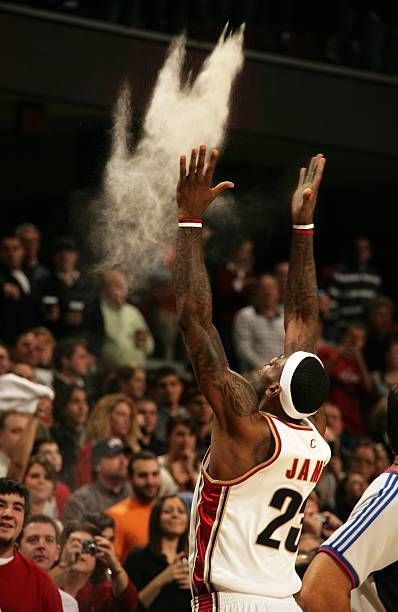
It costs him nothing, and it has outlasted three teams, four championships, and twenty-one years of a league that timed him out of it, literally. In 2012, the NBA capped pregame routines at 90 seconds specifically because of moments like his. A rule was written around a habit. That’s not superstition. That’s leverage.
It wasn’t designed. That’s the point.
James has said he doesn’t remember exactly when it started, somewhere in his second or third season in Cleveland. He was using the powder the way most players do: dry the hands, kill the sweat, tighten the grip. Then, almost by accident, he threw a little too much into the air one night. The crowd reacted. He noticed. He did it again. What began as friction management became, within a season, a piece of choreography 20,000 people waited for. He didn’t build a brand. A stadium built one for him, and he had the discipline to keep showing up for it, identically, every single night.
That sequence, accident, attention, repetition, identity, is the actual anatomy of a ritual. Almost none of them are invented on purpose. Michael Jordan’s version of the same chalk clap started in the late ’80s as a joke aimed at a broadcaster he wanted to needle. Kevin Garnett did his to unsettle the media. James took the same physical gesture and, without changing the mechanics, turned it into something closer to a devotional. Same dust. Three completely different psychological jobs.
The science backs the theater.
This isn’t just a nice story, it’s measurable. A 2010 study in Psychological Science found that golfers told they were putting with a “lucky ball” sank significantly more shots than golfers using an identical, unlabeled ball, a nearly 35% jump in success rate from belief alone. Researchers at Colgate found the same lucky-charm effect boosted performance on memory and dexterity tasks, tracing it to a rise in self-efficacy: the belief that you, specifically, can execute under pressure. A 2023 study out of Southwestern University of Finance and Economics and Beijing Sport University went further, showing ritualized behavior directly improves inhibitory self-control, the exact mental muscle an athlete needs to ignore 20,000 screaming strangers and make a free throw.

Olympic swimmer Stephanie Rice swung her arms exactly eight times and pressed her goggles four times before every race. Cristiano Ronaldo steps onto every pitch right footfirst. None of it moves the needle physically. All of it moves the needle neurologically, converting an uncontrollable event (a game, a crowd, an opponent) into something that opens with one small, fully controllable act.
This is where it stops being personal and starts being cultural.
A ritual only becomes culture when the audience adopts it as their own. Kids in driveways mime the toss before free throws. Fans in the arena throw confetti in sync with him. Nike built a campaign around it. A video game put it on a cover. That’s the actual transfer of power in sports: James didn’t ask anyone to participate. He simply never stopped, and the crowd eventually folded the motion into their own experience of watching him. When he dropped it during his four years in Miami, a version of himself trying to be someone the public hadn’t fully accepted yet, fans noticed the absence before they noticed anything else. The ritual had become load-bearing. Its disappearance said more than its presence ever had.
That’s the real insight, and it travels far outside basketball: consistency, repeated without deviation long enough, stops reading as habit and starts reading as identity. Nobody remembers James inventing the chalk toss. Everyone remembers that he never once faked it.


Comments